
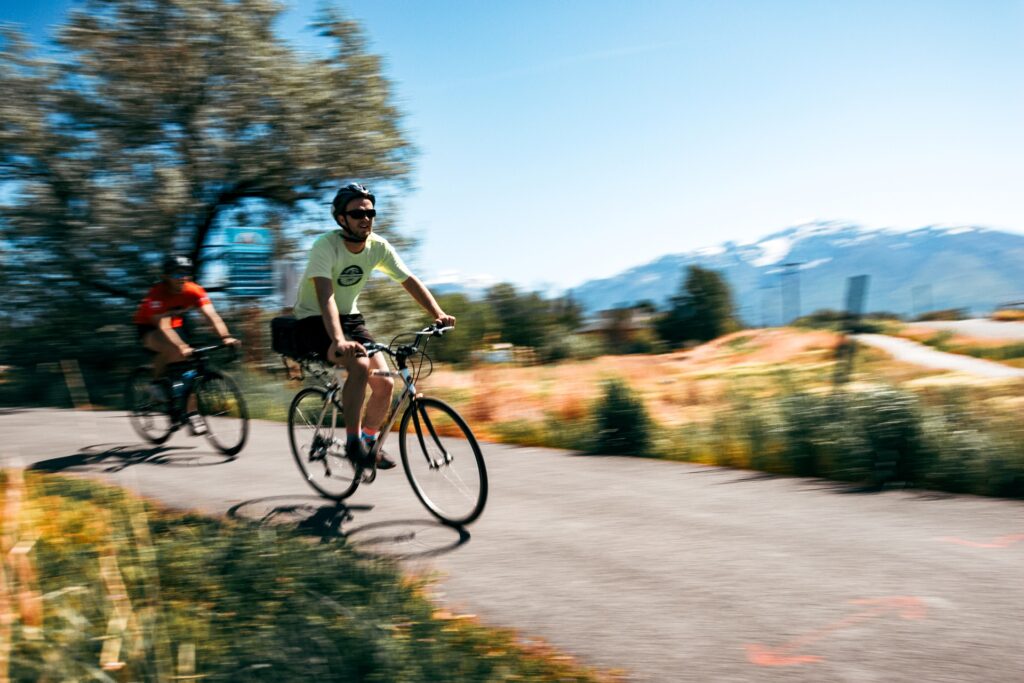
At the Jordan River Commission’s October Governing Board meeting, partners from across the Wasatch Front came together to discuss how to keep the Jordan River Trail safe, connected, and welcoming for everyone. The meeting explored topics from improving location information for better emergency response, to consistent signage for rules and etiquette, to thoughtful trail design and adoption of speed limits. Local governments and community organizations are collaborating to make the trail a safer, more enjoyable place to walk, ride, and explore. Share your experiences by completing a brief public safety survey at the end of the article!
Keeping the Jordan River Trail Safe for Everyone
The Jordan River Parkway is one of Utah’s beloved outdoor spaces. The 46-mile Jordan River Trail connects Utah’s most densely populated region, across 16 cities in Utah, Salt Lake, and Davis counties. It’s a place for walking, running, cycling, exploring, and reconnecting with nature. As the trail continues to grow in popularity, public safety has become an increasingly important topic, and a concern. At a recent meeting of the Jordan River Commission Governing Board, local governments, emergency responders, and community partners came together to discuss how to keep the trail safe, connected, and welcoming for all users.
New Kinds of Motorized Devices and Users Bring New Safety Concerns
Jordan River Commission Executive Director Soren Simonsen noted in the meeting that the proliferation of e-bikes, scooters, and other large and small electric motorized mobility devices has introduced new challenges.
As a reminder, most motorized vehicles and mobility devices are not allowed on the Jordan River Trail — including motorcycles, e-bikes, motorized scooters, motorized boards and one-wheelers, motorized all-terrain vehicles (ATVs), and similar devices — whether electric or gas-powered. If you see these on the trail, please report to the local law enforcement agency where such activity is observed. There are a few exceptions allowed under state law, such as assistive mobility devices, like an electric wheelchair, or a Class 1 e-bike, which is pedal assisted only (i.e. – you must pedal to operate, with no throttle and a maximum speed of 20 mph). Golf carts are also not allowed on the trail, except where the trail merges with golf cart paths for short stretches of golf courses near the river.
“There are increasing reports of crashes and near misses,” Simonsen said, referencing a recent incident that left a trail walker seriously injured and hospitalized. “We’re hearing from residents who are concerned about speeding and motorized devices, blind corners, and limited visibility under bridges or in shaded areas.”
The Jordan River Commission is collaborating with local governments and their law enforcement agencies to address these issues and develop solutions. If you witness or experience an injury or crime that is in progress, please call 911 right away. This includes bicycle collisions, dog bites, or vandalism. For non-urgent matters, you can reach out to the local law enforcement. Some cities even have anonymous tip lines. Keep in mind that the trail goes through many jurisdictions, so check your physical location before calling.
Helping Emergency Responders Find You Faster
Matt Schultz from the Salt Lake Valley Emergency Communications Center (Salt Lake County’s 911 dispatch center) joined the Governing Board meeting. He has been a proactive collaborator in addressing public safety concerns along the Jordan River Parkway. He has been working to implement better ways to pinpoint the location of a reported emergency, which is not always apparent or obvious on the trail, and emphasized how important clear trail signage is when emergencies occur.
“When someone calls 911 from the Jordan River Trail,” Schultz said, “we rely on location information to get help to them quickly. Having signs and mile markers makes all the difference.”
Cell data isn’t always precise in wooded or shaded areas, so trail markers and signs help dispatchers pinpoint callers’ exact locations. Salt Lake City has already integrated trail signage into its 911 mapping system, which has significantly improved response times. Schultz encouraged other jurisdictions to do the same by collecting GPS coordinates using markers on trail signs or pavement.
“Every additional sign we add to the trail network improves response time,” he said. “It’s one of the simplest, most effective steps we can take to enhance safety.”
A Consistent Experience Across Cities and Counties
Because the Jordan River Trail passes through so many communities, consistency is key. Many jurisdictions manage their own trail signage and maintenance, which can create confusion for users and responders alike. Meeting participants emphasized the need for a unified safety and signage system along the entire Jordan River Trail, including and especially in areas where there is trail on both sides of the river. A consistent look and message could make navigation easier and reinforce safe trail behavior.
The Commission already has a standard trail sign program that includes templates for trailheads, mile markers, and pavement decals. Expanding this program across jurisdictions could create a cohesive and safer experience from Saratoga Springs to North Salt Lake.
“If everyone follows the same standards,” Simonsen said, “we can make the trail safer and more cohesive without reinventing the wheel in every city.” The Commission is exploring ways to fund further implementation of these systems.
Balancing Education, Design, and Access
Enforcement of trail rules remains a challenge because the trail runs through multiple jurisdictions and covers many miles. Instead of relying solely on enforcement, participants discussed focusing on education and design tools that can encourage safer behavior through awareness and thoughtful infrastructure.
The Governing Board discussed a range of potential responses, from additional signage reminding riders to slow down around pedestrians to physical design features that naturally reduce speed in busy areas.
Some ideas discussed in the meeting included tenth- or quarter-mile markers, or color-coded wayfinding decals, either on the pavement or on sign posts to improve user awareness and help identify specific locations for emergency response and user feedback. Other ideas included better sightlines at intersections, more visible markings and warnings near blind corners, and signage that encourages shared use between cyclists, pedestrians, and others. Some members are also interested in physically expanding the trail in some sections to give bikes a separate lane.
Investing in Safety Together
Several Commission members discussed ways to fund these improvements, such as using the Jordan River Recreation Area Program Fund, which supports local projects that enhance the trail corridor. Setting aside a portion of those funds for coordinated signage or safety initiatives could help the Commission implement improvements more quickly.
“This is something that benefits every community along the river,” Simonsen said. “A shared investment in safety serves us all.”
Next Steps: Building Safety Into the Future
Looking ahead, the Jordan River Commission will work with its Technical Advisory Committee and local partners to incorporate public safety strategies into updated Jordan River Parkway Design Guidelines. These guidelines will help cities and counties apply consistent standards for signage, trail layout, and safety features as they improve their respective sections of the trail.
From clearer signage to coordinated design and stronger collaboration among cities, these efforts reflect a shared commitment to keeping the Jordan River Trail a safe, enjoyable, and a welcoming place for everyone who uses it. Public safety along the trail isn’t just about emergency response; it’s about prevention, cooperation, and care for one of Utah’s most important regional corridors.
We want to hear from you! Please take a few minutes to complete our Jordan River Trail Public Safety Survey, linked below. Your feedback will be helpful as we work with our partners to address safety concerns, explore solutions, and ensure that the Jordan River Parkway is an enjoyable place for all.
Thank you for being part of the solution!
(Photo Credit: Sage Nightingale)