
By: Paul Burnett, Utah Division of Water Quality
Remember that riddle from grade school where the murder weapon is an icicle, which melts away and disappears before investigators arrive? Investigating a fish kill in a river or lake often feels the same way. By the time people notice dead fish and call it in, investigators rush to the scene, collect samples, and… nothing unusual shows up. The evidence is gone.
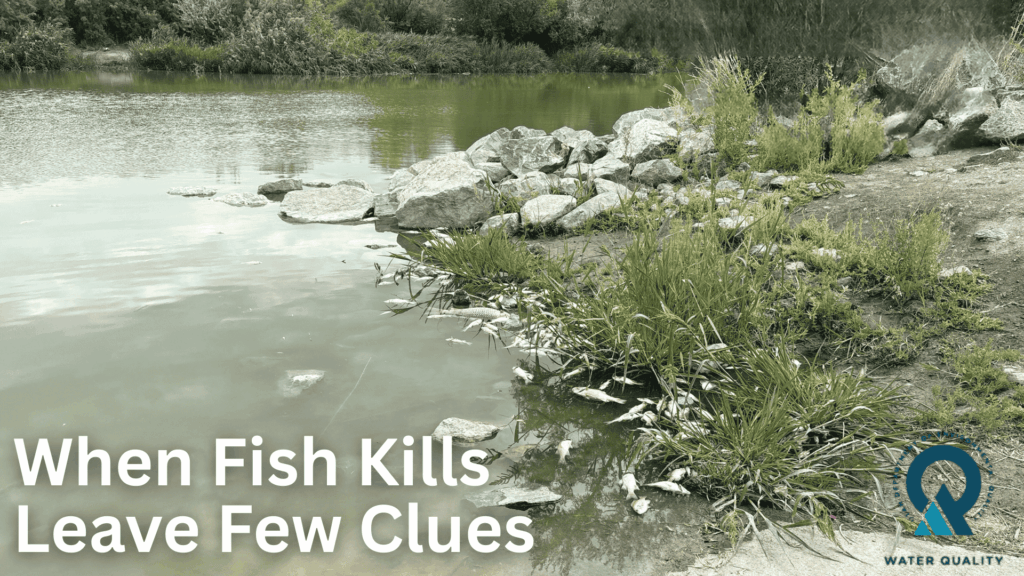
That’s exactly what happened twice this past August on the Jordan River. A fish kill was reported on the upper Jordan on August 14, and then again on the lower Jordan on August 27–28. Investigators arrived quickly, but water samples and site conditions looked normal. No smoking gun.
Fortunately, the Jordan River is wired with something better than guesswork: a network of continuous water-quality sensors operated by the Utah Division of Water Quality. These stations record temperature, dissolved oxygen, pH, salinity, and turbidity every 15 minutes and beam that data straight to our database. That gave us a nearly real-time window into what the fish were experiencing.
Mystery #1: Heat Stress
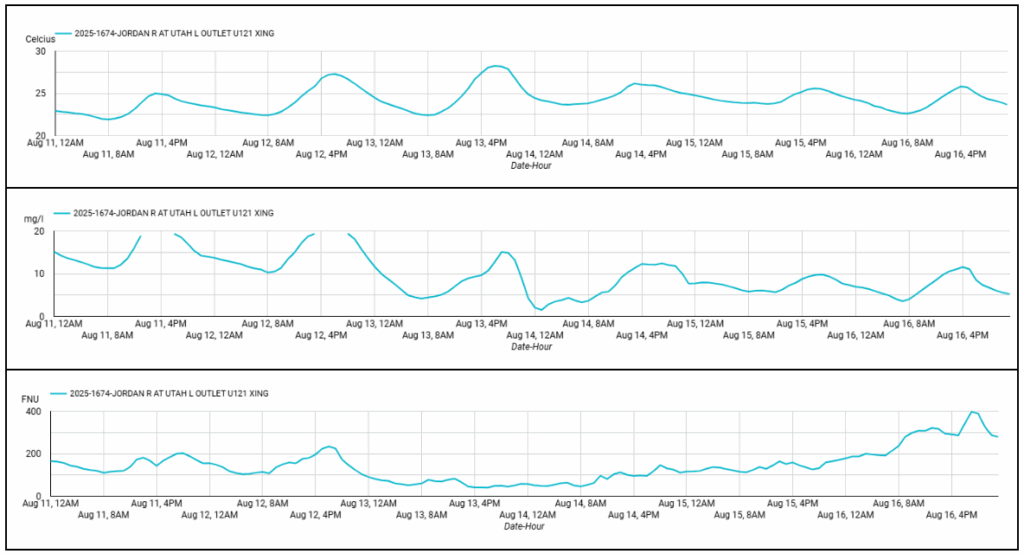
In the days leading up to the August 14 fish kill, water temperatures spiked to 28.2 °C (83 °F). That’s hot for a river in Utah, and stressful for fish. Warm water not only pushes fish to their physiological limits – they expend more energy, and require more oxygen – warm water also holds less oxygen. During the day, algae and aquatic plants release oxygen through photosynthesis, but at night photosynthesis stops while both plants and algae (and fish) continue to respire, consuming oxygen. That nighttime drawdown, combined with elevated temperatures, caused dissolved oxygen to plummet for several hours. When investigators visited Willow Park, the river looked like ‘pea soup’ with algae. A bloom that dense demands even more oxygen to respire, further depressing oxygen levels and limiting the river’s ability to recover. Turbidity (a measurement of water cloudiness) data at this location provides more clues about the amount of algae moving out of Utah Lake and into the Jordan River, and how much stress it puts on fish.
Mystery #2: The Stormwater Surge
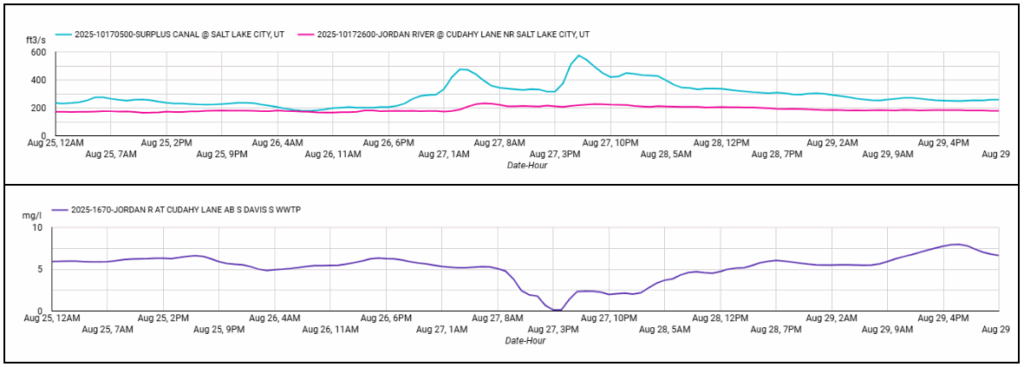
The late-August fish kill in the lower Jordan coincided with two massive summer rainstorms. Rain had not occurred for 103 previous days and the August 26-27 rain storms flushed a season’s worth of oil drips from our cars, lawn fertilizer, pet waste, and sediment off our streets and into the Jordan River. Flow doubled almost overnight, which stirred up river sediments. The surge of water was dosed with a spike of nutrients and organic matter from the stormwater. As those pollutants broke down, they consumed oxygen in the river, leading to more than 12 hours of dangerously low oxygen levels.
What Ties These Events Together?
Both events boiled down to the same root causes: heat and nutrient enrichment. In late summer, turbidity readings and on-the-ground observations showed the river turning pea soup green with algae. High algae density is a classic symptom of eutrophication, often driven by excess nutrients. Nutrients are things like nitrogen and phosphorus, which come from fertilizers, pet waste, and organic debris. Although important for aquatic ecosystems, in excess they fuel unchecked algae growth that overwhelms a waterbody’s natural balance. During the day, these blooms can pump oxygen into the water, but at night they consume it in large amounts, creating extreme daily swings in dissolved oxygen. After a long, hot summer, Utah Lake and the Jordan River hit tipping points where oxygen was quickly stripped from the water, leaving fish with nowhere to swim.
What Can We Do?
These fish kills are reminders that our everyday actions are linked to the health of our rivers and lakes. Solutions include:
- Reducing pollution in stormwater runoff: avoid overapplication of irrigation water and fertilizer, pick up pet waste, and keep grass clippings, leaves and other organic matter away from gutters and stormwater drains.
- Expanding “low impact development”: Tools like rain gardens, vegetated swales, and stormwater retention basins slow down runoff and filter pollutants before they reach our waters.
- Supporting restoration efforts: Utah Lake and the Jordan River are both stressed ecosystems in need of continued restoration strategies to manage nutrients, flows and protect floodprone areas.
Even small steps matter. When we reduce runoff and pollution in our neighborhoods, we’re helping protect the fish, wildlife, and communities connected to Utah Lake and the Jordan River.
Want to learn more?
Here are a few resources from the Division of Water Quality:
- Jordan River Dissolved Oxygen TMDL: Watershed Management Program
- Utah Recreational Water Quality Monitoring
- Jordan River Recreational Water Monitoring
- What are Harmful Algal Blooms?